

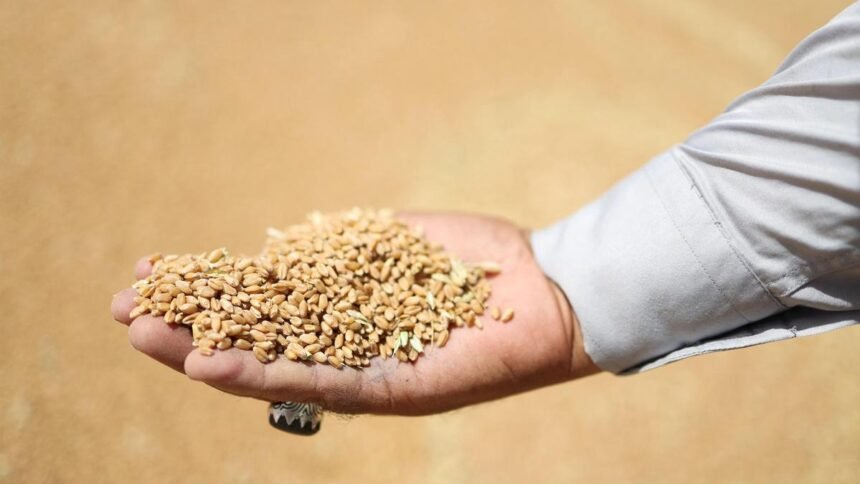
The government’s wheat procurement rose 17 per cent to over 35 million tonnes in the 2026-27 rabi marketing season, surpassing both the target of 34.5 million tonnes and the previous year’s procurement of 30 million tonnes, a senior food ministry official said on Wednesday .
“Wheat procurement has crossed 35 million tonne so far this season. We have exceeded the target. Procurement in major producing states has been completed,” the official told PTI . The Food Corporation of India (FCI) and state agencies procure wheat at the minimum support price (MSP) to meet requirements under the National Food Security Act and other welfare schemes .
Record production drives higher purchases
Higher procurement was facilitated by mandi rates ruling below the MSP, owing to robust domestic production of 120.65 million tonnes — a record high — sustained despite localised crop damage from unseasonal rainfall and hailstorms . The MSP for the 2026-27 season has been set at Rs 2,585 per quintal, up from Rs 2,425 in the previous year .
State-wise, Punjab led procurement at 12.1 million tonnes, up from 11.9 million tonnes in the previous season. Madhya Pradesh recorded a sharp jump to 10.4 million tonnes from 7.8 million tonnes, while Haryana rose to 8.1 million tonnes from 7 million tonnes .
Uttar Pradesh nearly doubled its procurement to 1.7 million tonnes from 1 million tonnes, and Rajasthan improved to 2.4 million tonnes from 1.9 million tonnes .
Relaxed quality norms boost procurement
The government relaxed quality norms for wheat procurement in key states following unseasonal rains that caused widespread lustre loss. In Punjab, almost the entire quantity purchased was under relaxed quality specifications . The food ministry allowed grain purchase with up to 70 per cent lustre loss and increased the shriveled or broken grain limit to 15 per cent from the existing limit of 6 per cent .
Of the total 34.99 million tonnes procured as of May 31, 23.63 million tonnes — over 67 per cent — were purchased under relaxed quality specifications .
Massive buffer stock accumulation
With 35 million tonnes of wheat procurement this year, the central pool stock, maintained by the FCI, now stands at 51.3 million tonnes against the buffer norm (as on July 1) of 27.5 million tonnes . The buffer stock requirement is only around 7.5 million tonnes, with a strategic reserve of about 20 million tonnes.
The FCI currently has over 41.69 million tonnes of wheat as central pool stock against a buffer and strategic reserve norm of 27.58 million tonnes for July 1 .
Madhya Pradesh overcomes initial challenges
Madhya Pradesh’s procurement journey was particularly notable. Until April 30, procurement in the state was lower by 59 per cent despite being allowed to start from March 15, due to infrastructure constraints including inadequate gunny bags and purchase centres . However, following sustained pressure from farmer organisations and the Opposition, the government managed to exceed the target, eventually procuring 10.44 million tonnes — up 34 per cent from the previous year’s 7.78 million tonnes .
The Centre had revised Madhya Pradesh’s procurement target upward from 7.8 million tonnes to 10 million tonnes in the last week of April, responding to requests from the state government .
Challenges ahead: Storage capacity and surplus management
Despite the achievement, the massive procurement has raised concerns about storage capacity. The FCI has been forced to raise a short-term loan of Rs 50,000 crore from scheduled banks to bridge cash flow mismatches arising from procurement and distribution of foodgrains, with an additional greenshoe option to raise Rs 25,000 crore more .
Industry experts note that storage remains a core constraint. As of April 1, 2026, the central pool had stocks of 60.40 million tonnes (both rice and wheat), leaving limited space for new procurement . With opening stocks estimated at 22 million tonnes for 2026-27, total availability could reach just over 56 million tonnes, far exceeding the annual PDS requirement of 18-20 million tonnes .
The surplus may force the government to liquidate excess stock through the Open Market Sale Scheme (OMSS), with sales expected to begin earlier than usual. Navneet Chitlangia, President of the Roller Flour Millers’ Federation of India, noted: “This leaves just 34.82 MT of space for new wheat procurement (target 34.53 MT) and incoming milled rice (33.50 MT). With limited storage headroom, wheat prices are unlikely to rise significantly after procurement ends” .
Praise for farmers and policy support
Union Agriculture Minister Shivraj Singh Chouhan hailed the achievement, stating on social media platform X: “India’s food security is our top priority. Our hardworking farmers have made this historic procurement possible” . Prime Minister Narendra Modi also congratulated farmers and state governments for their contributions to the record procurement.
The higher procurement has added to farmers’ incomes significantly. The total payout to wheat growers is estimated at approximately Rs 90,000 crore based on the MSP of Rs 2,585 per quintal. This will directly support rural livelihoods and consumption demand in the coming months.