
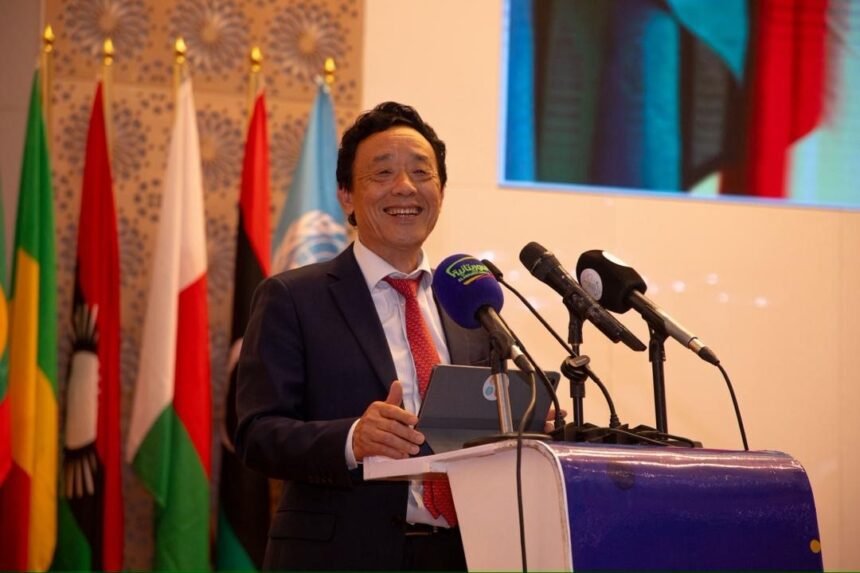
Africa’s burgeoning population of youth and women is one of the continent’s greatest assets, and must be empowered to drive positive change in regional agrifood systems, said Qu Dongyu, Director-General of the Food and Agriculture Organization of the United Nations (FAO), in remarks at the first-ever meeting of the World Food Forum (WFF) Africa.
The event took place on April 16, 2026, in Nouakchott, Mauritania, ahead of the Ministerial Meeting of the 34th Session of the FAO Regional Conference for Africa (ARC34).
“Youth and women are not only beneficiaries of transformation, they are the engines of change,” Qu said in his opening remarks.
What Is the World Food Forum Africa?
The World Food Forum was originally established in 2019 as a global platform to bring together stakeholders across the agrifood sector. The launch of a regional chapter for Africa localizes these efforts, making the initiative more:
- Action-oriented
- Inclusive
- Investment-focused
The goal is to respond directly to Africa’s agrifood system priorities, bridging the gap between vision and delivery by connecting science, innovation, investment, and youth and women empowerment.
Key Voices at the Inaugural Event
Wednesday’s event featured several prominent speakers:
| Speaker | Role | Key Message |
|---|---|---|
| Qu Dongyu | FAO Director-General | Youth and women are engines of change |
| Mohamedou Ahmedou Mhaimid | Minister of Agriculture, Mauritania | Host country commitment to transformation |
| Charles Spillane | FAO Chief Scientist | Half of Africa’s population is under 19; most work in poorly paid informal jobs |
| Maximo Torero | FAO Chief Economist | Presented local angles on FAO’s Hand-in-Hand Initiative |
FAO Chief Scientist Charles Spillane delivered a keynote address on integrating youth leadership with investment and innovation for a sustainable agrifood future. He noted that half the continent’s population is under 19, and the majority work in poorly paid informal jobs.
The Challenge – Fragmented and Misaligned Financing
Qu Dongyu highlighted a critical barrier to transformation: development finance for food security and nutrition in Africa has increased only modestly and remains fragmented.
| Issue | Detail |
|---|---|
| Fragmentation | Funds are spread across too many small projects |
| Dependence on ODA | Highly dependent on Official Development Assistance |
| Misalignment | Often misaligned with long-term nutrition, climate, and equity goals |
| Domestic spending | Growing but often favors short-term needs over high-impact public goods (e.g., irrigation, rural infrastructure) |
“Transformation requires investment – at scale and with impact,” Qu said.
He emphasized that inclusion is not optional – it is essential for productivity, resilience, and social stability. Africa’s greatest asset is its people, especially youth, women, and smallholders, yet they remain systematically underserved by financial systems.
The Opportunity – Repurposing Support and Private Investment
According to Qu, repurposing support and incentivizing private investment remains one of the largest untapped opportunities to accelerate transformation in Africa.
Instead of relying solely on aid, the WFF Africa model aims to shift from donation-based development to investment-based partnerships. This approach:
- Encourages private sector participation
- Rewards measurable outcomes
- Builds long-term capacity rather than short-term fixes
FAO Chief Economist Maximo Torero also presented local and actionable angles on FAO’s flagship Hand-in-Hand Initiative, which uses advanced data analytics to match investments with the areas of greatest need.
Special Events – Showcasing Young Entrepreneurs
Workshops and sessions during WFF Africa showcased the achievements of several young entrepreneurs and offered dialogue opportunities with important local actors in research and investment.
Key Focus Areas for Investors
| Region | Investment Focus |
|---|---|
| Small Island Developing States | Financing opportunities in FAO programmes |
| Sahel Region | Irrigation projects |
| Southern Africa | Agroprocessing, mechanization, and trade |
Potential investors were invited to speak on panels dedicated to these specific financing opportunities. The host country, Mauritania, also briefed attendees on the outcomes of the Hand-in-Hand Investment initiative within its borders.
International Year of the Woman Farmer – Africa Launch
The event concluded with the inauguration of the International Year of the Woman Farmer in Africa. This global initiative recognizes the critical role that women play in agriculture – from production to processing to marketing.
A call to action was delivered by Fatmata Binta, an innovative chief who serves as FAO Regional Goodwill Ambassador for Africa. She urged governments, investors, and communities to prioritize women farmers in policy and investment decisions.
Looking Ahead – ARC34 Ministerial Session
The high-level Ministerial Session of ARC34 opens on Thursday, following the WFF Africa events. Ministers from across the continent will discuss:
- Progress toward sustainable agrifood systems
- Investment priorities for the coming year
- Implementation of the Hand-in-Hand Initiative
- Follow-up actions from the World Food Forum Africa
People-Centered Transformation
The first World Food Forum Africa sent a clear message: Africa’s agrifood transformation cannot succeed without its people. Youth, women, and smallholders are not passive recipients of aid – they are active agents of change.
As FAO Director-General Qu Dongyu stated, inclusion is essential for productivity, resilience, and social stability. The challenge now is to align financing – both public and private – with that vision.
With half of Africa’s population under 19, the continent has a demographic dividend that, if properly harnessed, could drive sustainable growth for decades. The World Food Forum Africa provides a new platform to make that happen – shifting from donation to investment, and from fragmentation to focus.
The inaugural event in Nouakchott may prove to be a turning point. As one participant noted: “Africa’s greatest asset has always been its people. Finally, our policies are catching up to that reality.”