
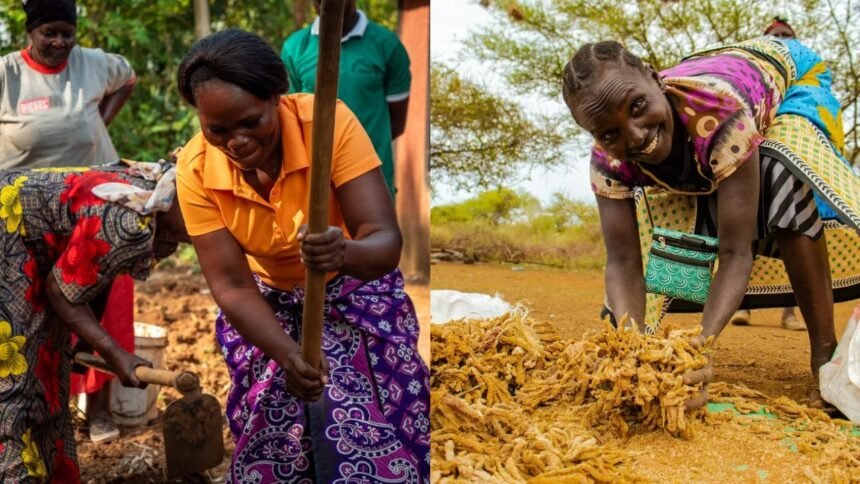
Women play a central role in agrifood systems across sub-Saharan Africa, and their contributions present a major economic opportunity. According to a recent report by the Food and Agriculture Organization (FAO) , closing gender gaps in this sector could increase $53 billion in economic value , while boosting productivity, incomes, and regional growth.
The report, “The Status of Women in Agrifood Systems in Sub-Saharan Africa,” highlights that 76 per cent of working women in sub-Saharan Africa are employed in agrifood systems – the largest share worldwide.
Women’s Participation – By the Numbers
| Metric | Percentage |
|---|---|
| Working women in agrifood systems | 76% (largest share globally) |
| Women in off-farm activities (processing, packaging, distribution) | 29% (up from 21% in 2005) |
| Women in off-farm work in rural areas (vs. men) | 4x more likely |
| Women’s share of off-farm workforce in sub-Saharan Africa | 63% |
| Global average for women in off-farm workforce | 43% |
Women’s participation is especially strong in off-farm activities such as processing, packaging, and distribution, where their share has grown from 21 per cent in 2005 to 29 per cent in 2022. In rural areas, women are four times more likely than men to engage in off-farm work.
Overall, women make up 63 per cent of workers in these off-farm segments, compared to 43 per cent globally.
The Unpaid Care Burden – Essential but Unrecognized
Beyond paid employment, women contribute significantly through unpaid care work , including:
| Unpaid Activity | Importance |
|---|---|
| Food preparation | Household nutrition |
| Water collection | Essential for family and livestock |
| Caregiving | Children, elderly, sick family members |
These activities are essential for household food security and the stability of local food systems, yet they often go unrecognised and undervalued.
Structural Barriers – What Holds Women Back
Despite their major contributions, women face significant structural barriers.
| Barrier | Impact |
|---|---|
| Limited access to land | Men more likely to own land or hold secure land rights |
| Limited access to productive resources | Seeds, tools, credit, extension services |
| Lower access to social protection | Only 13% access cash benefits |
| Pension coverage | Less than 7% covered |
| Environmental degradation | Limits access to land, water, forests |
| Gender-based violence risk | Women and girls at increased risk |
In most countries across the region, men are more likely to own land or hold secure land rights. These disparities are further compounded by broader challenges, including rising food insecurity.
Food Insecurity – A Gendered Crisis
In 2024, food insecurity affected a higher percentage of women than men across the region.
| Metric | Women | Men |
|---|---|---|
| Moderate or severe food insecurity (2024) | 64.2% | 62.7% |
| Additional women affected | 11.2 million more women than men | — |
Consequences of Food Insecurity
| Consequence | Impact |
|---|---|
| Gender-based violence | Intimate partner violence, child marriage |
| Poor health outcomes | Anaemia, obesity among women |
The $53 Billion Opportunity – Closing the Gap
These disparities reduce productivity and limit economic potential. The report estimates that closing gender gaps in productivity and wages could deliver significant benefits:
| Benefit | Estimated Impact |
|---|---|
| Regional GDP increase | 2.58% |
| Equivalent economic value | $53 billion |
| Food insecurity reduction | 3.79% |
$53 billion is a conservative estimate of the additional economic value that could be unlocked by empowering women in agrifood systems.
Policy Recommendations – Toward Gender-Just Agrifood Systems
To address these challenges, the report calls for a shift toward gender-just agrifood systems through transformative policy actions.
| Action Area | Specific Measures |
|---|---|
| Address unequal access to resources | Land rights, credit, extension services |
| Redistribute unpaid care work | Recognize, reduce, and redistribute care burden |
| Strengthen women’s decision-making power | Leadership roles, collective action |
| Expand social protection | Cash transfers, pensions, health coverage |
| Challenge discriminatory norms | Legal reforms, community engagement |
| Invest across value chain | Production, processing, marketing, distribution |
The report emphasises the importance of expanding social protection, challenging discriminatory norms, and investing in women across the entire agrifood value chain.
Report Partners and Launch
The report was developed by:
| Partner | Role |
|---|---|
| Natural Resources Institute of the University of Greenwich (NRI) | Research and analysis |
| African Women in Agricultural Research and Development (AWARD) | Regional expertise and collaboration |
Launch Event
The report was launched on April 16, 2026 , at the first World Food Forum – Africa , held on the margins of the 34th Session of the FAO Regional Conference for Africa in Nouakchott, Mauritania.
Why This Matters – Beyond Economics
Empowering women in agrifood systems is not only a matter of equality but also a critical step toward:
| Goal | Connection |
|---|---|
| Economic growth | $53 billion GDP opportunity |
| Food security | 3.79% reduction in food insecurity |
| Sustainable development | Environmental and social sustainability |
| Resilience | Stronger local food systems |
| Gender equality | Rights, recognition, and redistribution |
As the report states: “Ultimately, empowering women in agrifood systems is not only a matter of equality but also a critical step toward economic growth, food security, and sustainable development in sub-Saharan Africa.”
A $53 Billion Case for Action
The FAO’s report makes a clear, data-driven case: closing gender gaps in sub-Saharan Africa’s agrifood systems is not just the right thing to do – it is a massive economic opportunity.
| Key Takeaway | Implication |
|---|---|
| 76% of working women in agrifood systems | Largest share globally |
| Women are 63% of off-farm workforce | Dominant role in processing, distribution |
| Barriers persist | Land, resources, social protection |
| Food insecurity higher for women | 11.2 million more women affected |
| $53 billion opportunity | 2.58% GDP increase |
| 3.79% reduction in food insecurity | Direct human benefit |
The report’s recommendations – addressing unequal access to resources, redistributing unpaid care work, strengthening women’s decision-making power, expanding social protection, and challenging discriminatory norms – provide a roadmap.
For policymakers, donors, and development organizations, the message is clear: invest in women. The returns are measured not only in dollars but in food security, resilience, and human dignity.
As the report concludes: “Empowering women in agrifood systems is not only a matter of equality but also a critical step toward economic growth, food security, and sustainable development in sub-Saharan Africa.”