
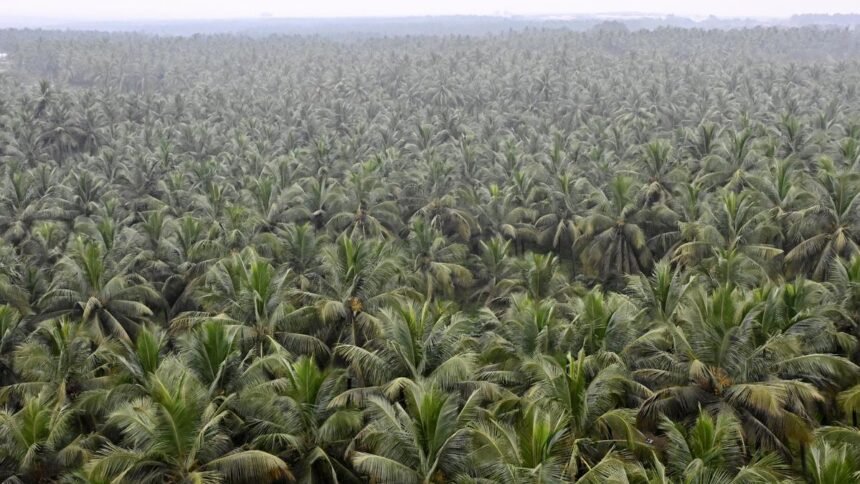
The 2026-27 Union budget announced a ‘Coconut Promotion Scheme’ with the primary aim of improving productivity by rejuvenating old, non-productive gardens with high-yielding coconut varieties and establishing new plantations along the coast.
The farming community has welcomed the announcement.
The Coconut Development Board (CDB) is already implementing a similar scheme, which has helped rejuvenate old gardens and expanded cultivation into non-traditional areas, including parts of Gujarat, Assam, and other non-peninsular regions — sufficient to partially offset the widespread destruction of coconut palms in Kerala and Tamil Nadu by disease.
However, the article’s title — and the argument it appears to make — suggests that the scheme must not be limited to distributing high-yield seedlings alone. The key to coconut cultivation today, it argues, is sustainability, not productivity.
The Problem with a Productivity-Only Approach
While improving productivity is important, focusing solely on high-yield varieties misses a critical reality: India’s coconut-growing regions face different and specific environmental pressures.
The east coast and peninsular regions face different climate challenges compared to the west coast. What works in one region may fail in another.
A productivity-only approach also ignores the fact that high-yield varieties often require more water, more fertilizer, and more intensive management — resources that small farmers may not have.
What the Scheme Should Prioritize
According to the article, the Coconut Promotion Scheme must prioritize:
First, the development and mass multiplication of climate-resilient varieties for farms along the east coast and in peninsular regions. These areas face different weather patterns, soil conditions, and disease pressures compared to traditional coconut-growing belts.
Second, the development of wilt-tolerant varieties for coconut-growing regions along the west coast (primarily Kerala and coastal Karnataka). Wilt disease has devastated coconut palms in these regions, and simply replanting with high-yield varieties that are not wilt-tolerant will lead to repeated losses.
The Reality of Coconut Cultivation in India
India is one of the world’s largest producers of coconuts. Major coconut-growing states include Kerala, Tamil Nadu, Karnataka, Andhra Pradesh, West Bengal, Gujarat, Maharashtra, and Odisha.
However, traditional coconut-growing regions — particularly Kerala and Tamil Nadu — have faced significant challenges in recent years:
- Wilt disease has destroyed thousands of hectares of coconut palms
- Climate change has altered rainfall patterns, affecting yields
- Aging plantations with declining productivity
- Labor shortages and rising input costs
The CDB’s existing scheme has helped rejuvenate old gardens and expand cultivation into non-traditional areas. But the scale of destruction in Kerala and Tamil Nadu is such that this expansion has only partially offset the losses.
Why Sustainability Matters More Than Productivity
Sustainability in coconut cultivation means:
Climate resilience — varieties that can withstand drought, flooding, and temperature extremes. As climate change intensifies, varieties that thrived in past conditions may fail in future conditions.
Disease resistance — particularly wilt tolerance for west coast regions. Replanting with wilt-susceptible varieties is a short-term solution that leads to long-term losses.
Soil health — avoiding practices that degrade soil over time. High-yield varieties often require intensive inputs that can deplete soil nutrients.
Water efficiency — varieties that produce well under rain-fed conditions, without requiring extensive irrigation.
Economic sustainability — ensuring that small and marginal farmers can afford the inputs required and can survive crop failures.
The East Coast vs. West Coast Divide
India’s coconut-growing regions are not uniform. The east coast (Tamil Nadu, Andhra Pradesh, Odisha) faces different conditions than the west coast (Kerala, Karnataka, Maharashtra).
East coast regions: generally drier, more prone to cyclones and storm surges, different pest and disease pressures.
West coast regions: higher humidity, more rainfall, particular vulnerability to wilt disease.
A one-size-fits-all approach — distributing the same high-yield seedlings across all regions — will fail. The scheme must develop region-specific varieties tailored to local conditions.
What Farmers Need
Farmers in coconut-growing regions need:
First, access to climate-resilient and wilt-tolerant seedlings — not just high-yield varieties.
Second, technical support on planting, maintenance, and disease management.
Third, financial support during the long gestation period (coconut palms take 5-7 years to reach full production).
Fourth, market linkages to ensure that increased production translates into increased income.
The Coconut Promotion Scheme, if designed well, could provide all of these. If designed poorly — focused only on distributing seedlings without considering sustainability — it could waste resources and fail farmers.
The Role of the Coconut Development Board
The Coconut Development Board (CDB) has been implementing schemes for coconut cultivation for many years. It has experience in:
- Rejuvenating old gardens
- Expanding cultivation into non-traditional areas
- Research and development of new varieties
The CDB is well-positioned to implement the new Coconut Promotion Scheme. However, the scheme must give the CDB the mandate and resources to focus on sustainability — not just productivity.