
The International Crops Research Institute for the Semi-Arid Tropics (ICRISAT) will serve as the South Asia hub for Breeding Resources , part of CGIAR’s Breeding for Tomorrow (B4T) Science Program , which offers shared tools and services to speed up crop improvement and drive agricultural innovation.
This partnership adopts a unified implementation model , where ICRISAT will deliver breeding and research services in South Asia following the same high standards, operational protocols, and workflows used by other Breeding Resources hubs globally — such as the International Rice Research Institute (IRRI) in Asia and AfricaRice in West and Central Africa.
This approach guarantees consistent quality and value for breeders and researchers, regardless of the service provider.
What Does ICRISAT as a Breeding Resources Hub Mean?
By adopting this system-wide model, ICRISAT is formally embedding Breeding Resources’ harmonized service delivery into its operations, building on a trusted and proven framework.
Whether breeders from the region are from CGIAR or national research institutes (NARES) , they can access services — from genotyping to phenotyping, and analytics to process management — delivered consistently across CGIAR Breeding Resources’ network of global hubs.
This means that a breeder in India, Pakistan, Bangladesh, Nepal, or Sri Lanka can access the same world-class breeding tools and services as a breeder at IRRI in the Philippines or AfricaRice in Senegal.
Why This Matters: Standardized, Integrated, Cost-Effective Services
Breeding Resources’ strength lies in its ability to offer integrated, standardized, and evolving cost-effective services.
Each regional hub operates as part of a connected ecosystem , where services:
- Follow the same Standard Operating Procedures (SOPs)
- Use shared digital tools like the Enterprise Breeding System and Bioflow
- Collect and process data in a harmonized way
This unlocks cross-Center and NARES synergies , promotes continuous improvement, and supports CGIAR’s mission to deliver better varieties more efficiently and faster.
Services Offered by ICRISAT as Breeding Resources Hub
ICRISAT offers five types of breeding services through the Breeding Resources Service Request Portal:
First, Genotyping and Sequencing Services — understanding plant DNA to identify traits like drought resistance or high yield. This includes DNA extraction, low-density, mid-density, and high-throughput genotyping, and sequencing.
Second, Elemental and Compositional Analysis — quick, non-destructive testing of crops to boost food quality. ICRISAT uses Near-Infrared Spectroscopy (NIRS) for protein, fatty acids, oil, moisture, and fodder quality traits (non-destructive, allowing assessment of 200-300 samples per day with multiple traits simultaneously). It also uses X-Ray Fluorescence (XRF) for mineral elements like iron, zinc, and calcium (non-destructive, 200-250 samples per day).
Third, Data Analytics Support — turning raw data into decisions. This includes scaling of Bioflow (CGIAR’s breeding analytics pipeline) across Centers and partners, and implementation and troubleshooting of the Enterprise Breeding System (CGIAR’s breeding data management platform) in South Asia.
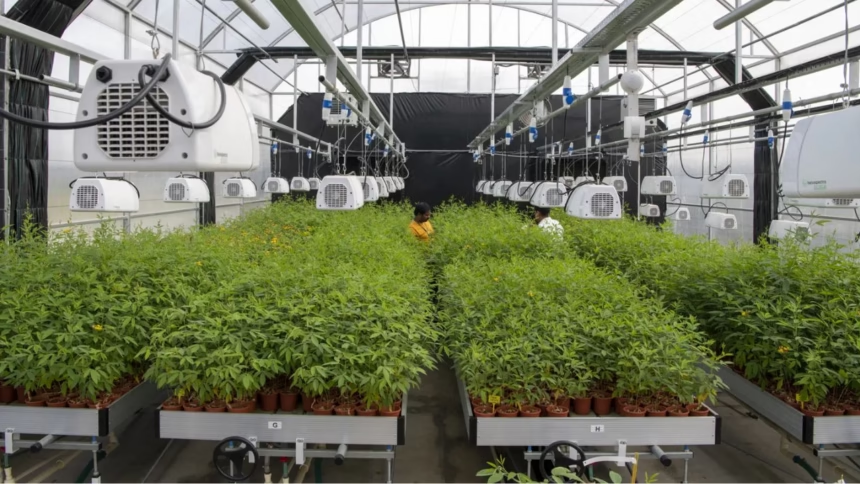
Fourth, Breeding Operations Support — improving variety development and trial efficiency. This includes support for trials, nurseries, and seed multiplication; seed-to-seed operations (land preparation, pre- and post-harvest data capture, irrigation systems, harvesting, and seed processing); and use of Rapid Generation Advancement (RGA) technologies, including Speed Breeding.
Fifth, Business Process Management — improving how breeding is done. This includes creation of Standard Operating Procedures (SOPs) and Research Operational Standards to improve core processes and enhance productivity, quality, efficiency, and customer satisfaction; and capacity building resources (both in-person and virtual training programs) to improve processes and foster adoption of new technologies.
ICRISAT’s Proven Track Record
Dr. Himanshu Pathak , Director General of ICRISAT, emphasized the organization’s readiness to deliver standardized breeding services across South Asia, building on decades of regional experience and infrastructure.
He highlighted ICRISAT’s impressive track record:
- Developing over 500 crop varieties
- Distributing nearly 600,000 germplasm samples to countries in the region
These varieties include drought-tolerant chickpeas, pest-resistant pigeonpeas, nutrient-dense sorghum and millet, and groundnut varieties with improved oil content.
Crop Varieties Developed by ICRISAT
ICRISAT has developed hundreds of crop varieties that have been released in South Asian countries:
Chickpea: drought-tolerant, fusarium wilt-resistant, and high-yielding varieties for India, Pakistan, Nepal, and Bangladesh.
Pigeonpea: early-maturing and wilt-resistant varieties that fit into rice-based cropping systems.
Groundnut: varieties with high oil content (for edible oil), disease resistance (rust and late leaf spot), and drought tolerance.
Sorghum and Pearl Millet: nutrient-dense (high iron and zinc), drought-tolerant varieties for rain-fed regions.
Small Millets (Finger millet, Foxtail millet, etc.): climate-resilient, high-nutrition varieties for semi-arid regions.
These varieties have improved the incomes, nutrition, and climate resilience of millions of smallholder farmers across South Asia.
Germplasm Distribution: 600,000 Samples and Counting
ICRISAT holds one of the world’s largest collections of semi-arid tropical crop germplasm (seeds of different genetic varieties) in its Genebank in Hyderabad, India.
The institute has distributed nearly 600,000 germplasm samples to researchers, breeders, and farmers in South Asia and beyond.
This genetic diversity is the raw material for crop improvement — allowing breeders to select traits like drought tolerance, pest resistance, and high nutrition.
The CGIAR Breeding for Tomorrow (B4T) Program
Breeding for Tomorrow (B4T) is CGIAR’s global breeding Science Program, which aims to make food systems more productive, inclusive, and climate resilient.
B4T focuses on:
- Modernizing breeding pipelines across CGIAR and NARES
- Accelerating genetic gain (the rate at which crop varieties improve year over year)
- Developing climate-smart crops (heat-tolerant, drought-tolerant, flood-tolerant)
- Strengthening regional breeding networks (like the South Asia hub at ICRISAT)
Eng Hwa , Lead for Breeding Resources at B4T, underscored the shared commitment between ICRISAT and B4T to harmonize breeding efforts and provide high-quality support and tools to breeders throughout South Asia.
Shared Digital Tools: Enterprise Breeding System and Bioflow
Two digital tools are central to the Breeding Resources network:
Enterprise Breeding System (EBS): CGIAR’s breeding data management platform. It helps breeders track crosses, trials, and phenotypic data — from field notes to genomic predictions. ICRISAT will implement and troubleshoot EBS across South Asia.
Bioflow: CGIAR’s breeding analytics pipeline. It takes raw data from EBS and runs statistical analyses to identify the best-performing varieties. ICRISAT will scale Bioflow across Centers and partners.
These tools ensure that data collected in Hyderabad can be compared with data collected in Nairobi or Manila — enabling global collaboration.