
The Grain Ethanol Manufacturers Association (GEMA) has strongly refuted recent claims suggesting that one litre of ethanol consumes 10,000 litres of water, calling the figure “factually misleading and devoid of context.”
The association clarified that the widely cited number refers to the total lifecycle water footprint including rainfall during crop cultivation – not actual industrial water usage. Modern ethanol plants in India consume only about 3–5 litres of process water per litre of ethanol, supported by high-efficiency systems.
Maize emerges as preferred feedstock
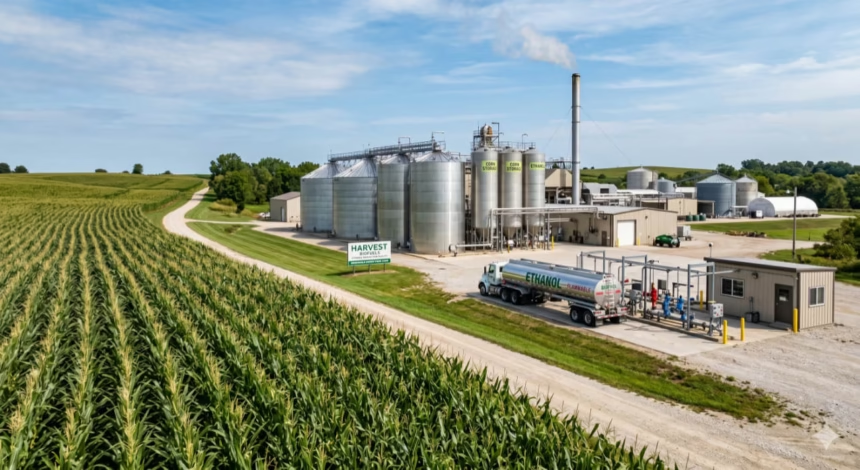
GEMA added that feedstock choices are also evolving, with maize – largely rain-fed – emerging as a preferred grain for ethanol production, reducing dependence on groundwater resources. In ESY 2023–24, grain-based ethanol overtook sugar-based production, reflecting a structural shift towards more sustainable inputs.
Among key feedstocks, maize is the least water-intensive and is largely rain-fed in India.
The water debate is incomplete
The association further noted that India’s ethanol debate has increasingly been reduced to a single question – whether blending fuel worsens water stress.
“This framing is misplaced and incomplete,” GEMA stated, “as it ignores both the distinction between rainfall and industrial water use, and the larger national context in which ethanol operates.”
Surplus grains become ethanol
GEMA also highlighted the critical role of surplus and damaged grains in the ethanol ecosystem. The government allocates large quantities of broken rice annually for ethanol production – grain that cannot re-enter the food supply chain due to quality constraints and excess buffer stocks.
“The water required to grow this grain has already been expended at the farm level. Converting it into ethanol is a waste-to-wealth solution that does not add to India’s water burden,” the association said.
Ethanol’s national benefits
India imports nearly 88–89% of its crude oil requirements, making energy security a critical national priority. The Ethanol Blended Petrol (EBP) Programme has already delivered:
- Foreign exchange savings exceeding Rs 1.7 lakh crore
- Reduction of CO₂ emissions by approximately 869 lakh metric tonnes
- Substitution of over 289 lakh metric tonnes of crude oil
- Farmer payments of over Rs 1.5 lakh crore
Industry leader speaks
Dr C.K. Jain, President of GEMA, said: “Calling ethanol a water guzzler is simply incorrect. The 10,000-litre figure is a misinterpretation that includes rainfall, not actual industrial usage. Today’s ethanol plants are highly efficient and continue to improve their water performance.”
He added: “India cannot afford misinformation around a programme that is reducing oil imports, supporting farmers, and cutting emissions. Ethanol is part of the solution, not the problem.”
Looking ahead
GEMA noted that India’s policy framework is already evolving beyond E20, with regulatory pathways being developed for E85 and E100 fuels. Maize and agricultural residues are expected to play an increasingly important role, further improving the environmental profile of ethanol production.
The association reiterated that informed, data-driven discourse is essential as India advances towards greater energy independence.