
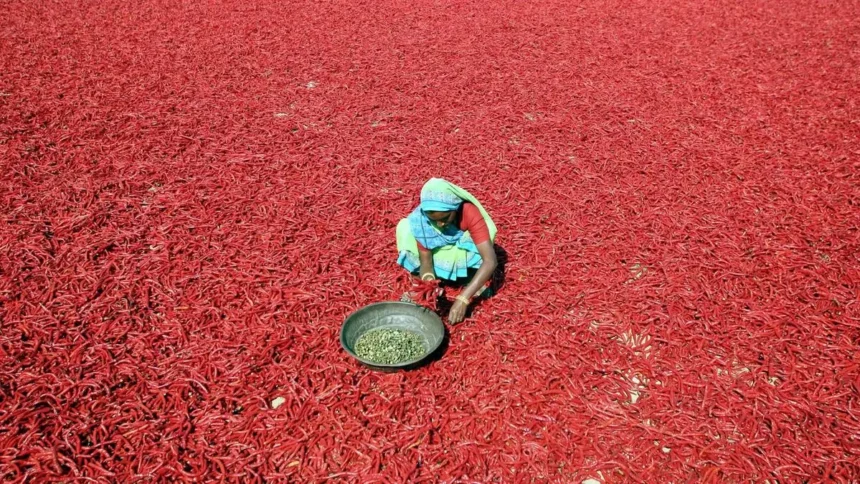
China, the largest buyer of Indian dried red chillies, has rejected multiple consignments and suspended three Indian exporters after detecting excessive levels of methamidophos residues in the shipments, raising fresh concerns about market access for Indian agricultural products .
The development comes just weeks after Beijing rejected nearly 70 consignments of Indian non-basmati rice, signalling a broader tightening of food safety standards for Indian agricultural exports .
What is methamidophos and why does it matter?
Methamidophos is a highly toxic organophosphate insecticide that can affect the nervous system. While the chemical is not separately registered for agricultural use in India, experts say residues may appear as a metabolite of acephate, another pesticide legally used by some chilli growers .
Chinese authorities reportedly found residue levels exceeding their permitted limits, prompting them to reject at least three cargoes and suspend the exporters involved .
“The detection of methamidophos in an exported chilli consignment is a matter of concern because methamidophos is not separately registered for agricultural use in India. However, methamidophos may occur as a metabolite of acephate, an insecticide that remains registered for use on certain crops in India and is reportedly used by some chilli growers,” said Bhagirath Choudhary, Founder Director of South Asia Biotechnology Centre .
Why China matters for Indian chilli exports
China is India’s largest overseas buyer of dried red chillies. India exported around 2.36 lakh tonnes of chillies to China in FY25, worth nearly ₹3,857 crore, accounting for more than a third of India’s total chilli exports .
China purchases primarily the Teja variety, which is used for oleoresin extraction, as well as for food processing and culinary applications. Annual shipments to China typically fluctuate between 1.5 and 1.9 lakh tonnes, but exports surged 31% in 2024-25 to reach a record 2.36 lakh tonnes .
No blanket ban, but heightened scrutiny
Trade sources indicate that China has not imposed a blanket ban on Indian chillies. Instead, authorities have targeted specific exporters and consignments that allegedly failed residue tests .
Notably, none of the affected shipments have been returned. Instead, importers and exporters are said to be negotiating price discounts to account for quality concerns .
According to trade sources, around 3,000 containers of chilli have been exported to China this year, of which 10-15 per cent reportedly faced quality issues, mainly due to excess moisture and pesticide residues .
A broader trend of tightening standards
Experts say the move reflects a broader trend rather than an isolated incident. Countries around the world are tightening food safety standards and increasing checks on pesticide residues, contaminants and traceability .
“Recent trade-related concerns involving agricultural consignments of rice and chilli indicate that China is exercising heightened scrutiny over food safety parameters, including pesticide residues and GMO-related requirements. Such incidents can affect the reputation of an entire commodity sector, even when they involve only a few consignments,” Choudhary said .
The heightened scrutiny from China comes at a challenging time for Indian chilli exporters, who are already facing reduced offtake due to ample carryover stocks in China and rising domestic chilli prices following a smaller crop this season .
What this means for Indian exporters
The immediate impact of the rejections could include slower shipments, higher testing costs and greater scrutiny at Chinese ports. Longer term, exporters may need to strengthen farm-level pesticide monitoring, residue testing before export, traceability systems, and quality-control practices across the supply chain .
Industry experts warn that maintaining access to premium export markets will increasingly depend on meeting stringent food-safety norms rather than simply offering competitive prices .
“India already faces a significant trade imbalance with China, and safeguarding market access for agricultural exports should be a strategic priority,” Choudhary said, calling for stronger farmer-awareness programmes, improved stewardship of crop-protection products, residue surveillance, and faster adoption of integrated pest-management practices .
Registration requirements remain in place
Indian exporters are required to register on China’s GACC system through the CIFER portal to be eligible to export spices to China. The Spices Board has previously clarified that ground spices can be exported without specific market access requirements, but CIFER registration remains mandatory .
For whole spices, including dried chilli, registration is handled through the Department of Animal and Plant Quarantine (DAPQ) of GACC, with applications processed through the Spices Board .
Outlook
The rejection of a few consignments may not significantly disrupt India’s chilli trade with China for now. However, it serves as a reminder that global agricultural markets are becoming more demanding on quality and compliance. For India, which aims to expand agricultural exports, the challenge is no longer just growing more produce—it is ensuring that every shipment consistently meets the increasingly strict standards of international buyers .