

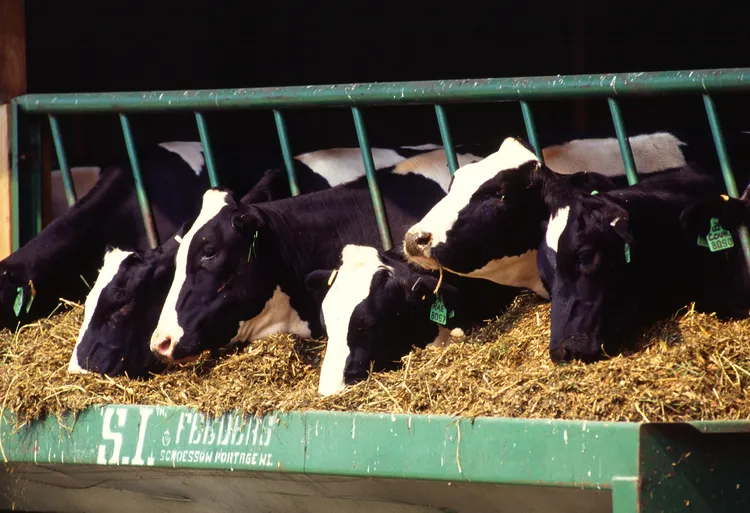
From stretching limited supplies to transitioning between feed sources, here’s how to keep your herd productive during tough times
Forage is a central part of a dairy cow’s diet, demanding careful attention from producers. This is especially vital in light of common challenges today, such as drought-stressed crops or restrictive financial situations.
We sat down with Jeff Weyers, dairy technical services manager with Zinpro Corporation, to discuss how dairy producers can stretch limited forage supplies, transition between sources of feed, and dial in when a ration doesn’t measure up to a herd’s needs.
Stretching Limited Forage Supplies
The goal with stretching forage supplies is to keep the rumen healthy with adequate fiber, Weyers said. When faced with limited forage supplies, producers can start replacing with byproduct feeds such as soyhulls or even straw at very low rates. Then, feed can be reformulated based on the rumen’s needs, such as bringing in some protein and energy.
These days, most dairies are working with a nutritionist, Weyers said, and that’s key. “Dairymen understand a lot about their feedstuffs and rations, but it becomes difficult when they start feeding byproducts: how they work, and how to reformulate the ration to maintain current production takes knowledge.” That’s where the value of a nutritionist and their expertise comes in.
If you don’t have a nutritionist on your dairy, there are still resources available. Weyers recommended consulting university research, Extension agents, and Zinpro dairy specialists. He cautioned about using rumen-formulation programs, which he described as “highly valuable if you know how to use them.”
Transitioning Between Forage Sources
When a producer does have to transition to a lower-quality forage, or even just between different sources, Weyers stressed the importance of making the shift over time. “Anytime I would make a ration change, I would never make an abrupt change from one day to the next, if possible,” he said.
For example, Weyers suggested blending lower-quality silage — such as that from the end of a drive-over pile, which could be poorer in quality — in with higher quality feed over a few weeks. He also recommended blending when switching sources of alfalfa hay.
“Blend the alfalfa hay… Maybe one week it’s 50/50, and then you find out that you’re getting into a little bit rougher hay or better hay, and the next week it may be 70/30,” he gave as an example.
That blending is going to be a producer’s best bet at not disrupting the rumen, Weyers explained. He said an overnight change with forage that is drastically differing in quality could disrupt fermentation and subsequent performance.
Tools for Evaluation
Tools to evaluate how you can make successful forage stretching and transitioning decisions include lab testing, manure analysis, and intake tracking.
Weyers considers forage lab analysis to be “100% necessary” for making decisions. Not every load has to be measured, but testing at certain points, such as when new forage comes in, or at the beginning, middle, and end of corn silage piles, is a good idea.
For example, when testing corn silage, producers will want to always be aware of moisture levels, starch levels, starch and fiber digestibility, as well as extent of kernel processing and chop length of the forage.
The primary basis for evaluating ration changes after the fact is manure and milk production. Nutritionists pay a lot of attention to the consistency of the manure. Understanding that and rumination, intake, body condition, rumen fill, etc. will provide a good indication how a ration is performing.
Another important indicator is whether dry matter intake changed significantly. “You want so much consistency,” Weyers said. Monitoring dry matter intake allows a producer to precisely track how groups of cows are reacting to ration changes.
“It’s just like what a restaurant would do,” he said. In fact, his advice is to treat your dairy like an efficient restaurant: Track ingredients to prevent shrink and spoilage, visually inspect mixing equipment and final product to make sure the recipe is correct, understand portion control, monitor what the cows are eating, and keep your customers — your cows — happy.
Target Feeding for Nutrient Deficits
Even if you’ve stretched limited supplies and tracked intake as efficiently as possible, there may still be gaps in your herd’s diet. Most ration balancing software is capable of identifying these nutrient deficits and ensuring that all dietary requirements are met.
Launched three years ago, Zinpro IsoFerm is a nutrient that can be added if the ration is deficient in isoacids. It is a “proprietary blend of branched-chain volatile fatty acids (isoacids) that directly feeds the rumen’s fiber digesting microbes to improve fiber digestion and protein utilization.”
The product improves the digestibility of fiber, thereby enhancing rumen fermentation so cows “can do more with less,” Weyers said. “In most cases, we’re seeing reductions in dry matter intake, along with an increase in energy-corrected milk, which results in improved feed efficiency