

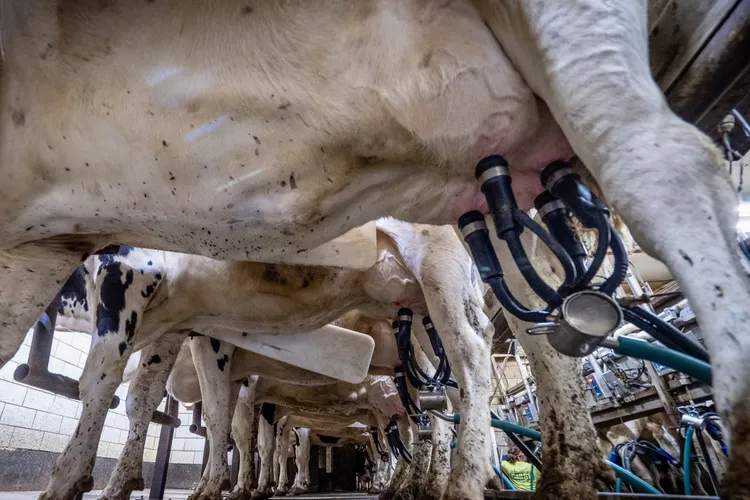
Des Moines, Iowa: When it comes to mastitis treatment in dairy cows, advances in understanding the course of the disease have changed antibiotic recommendations for the better — not only for the animal’s well-being but also the producer’s bottom line.
At the 2025 World Dairy Expo, Boehringer Ingelheim veterinarian Jen Roberts spoke about how distinguishing between infection and inflammation, different classes of pathogens, and short- and long-duration therapies can lead to more responsible antibiotic use in the parlor.
Infection vs. Inflammation
Roberts explained that when a cow shows clinical signs of mastitis — flakes and chunks in the milk or a swollen, hot, hard udder — there is no way to tell from outward signs alone whether bacteria are present or it is just inflammation.
“What we typically see in the case of mastitis is that within the first three days is where we’re going to have infection present. And then, once we’ve resolved the infection, either with the use of antibiotics or the cow just clearing it on her own, we usually see that it takes about another three days for the inflammation to resolve,” she said. “So, whether the cow has a positive culture at the time of diagnosis or not, it’s usually going to take about six days for the effects of the inflammation to resolve and the milk to return to normal.”
Culture-Guided Treatment
The surest way to know whether antibiotics are needed is to culture each case — either on-farm or through a lab. The goal is to broadly categorize the bacteria as Gram-positive, Gram-negative or no growth.
For Gram-positive cases, Roberts recommends the shortest-duration antibiotic treatment labeled for that pathogen. For Gram-negative cases, research has shown cows clear them effectively on their own. “Unless that cow is systemically ill, there’s no need to treat her. And even if she is systemically ill, we would treat her with supportive care… and no intramammary antibiotics,” she said.
“When we think about mastitis cases being in those three categories, and we’re going to focus our treatment just on those cows with Gram-positive mastitis, we’re going to reduce our antibiotic use by about two-thirds, if we use that strategy.”
An exception is contagious mastitis pathogens like Staphylococcus aureus or Streptococcus agalactiae, which warrant identification because they can spread between cows.
Why Short-Duration Works
“The Gram-positive cases are the ones that are more likely to result in chronic high-cell-count cows if we don’t treat them with antibiotics, so that’s why we’ve developed that guideline to focus on the Gram-positive cases and use a short-duration antibiotic therapy,” Roberts said.
Short-duration means therapy labeled for two or three days of treatment. Research has shown no difference in clinical or bacteriological cures between short-duration and longer-duration treatments.
Historically, protocols often included treating for five days or until milk visually returned to normal. But as Roberts explained, if bacteria are cleared by day three, stopping treatment at that point still leaves milk abnormal for about three more days due to residual inflammation — which is expected and does not require continued antibiotics.