
The foliar disease was confirmed in Culpeper County on July 17, marking the season’s first detection in the state
The season’s first case of tar spot in Virginia has been confirmed in Culpeper County, according to the latest maps published by the Crop Protection Network. The case of foliar disease was confirmed July 17. At press time, no other details of the case were available.
Four of Virginia’s 95 counties have a history of tar spot since it was first detected in the state in 2022. Cases have also been reported in Illinois, Indiana, Iowa, Kansas, Kentucky, Michigan, Minnesota, Missouri, Nebraska, and Wisconsin this year.
History of Tar Spot in Virginia
Tar spot was first confirmed in the northern Shenandoah Valley of Virginia in 2022. “Given its potential to cause significant yield losses, it is important for Extension agents and growers in Virginia to identify tar spot disease and stay informed about current management options,” urged a publication from Virginia Cooperative Extension.
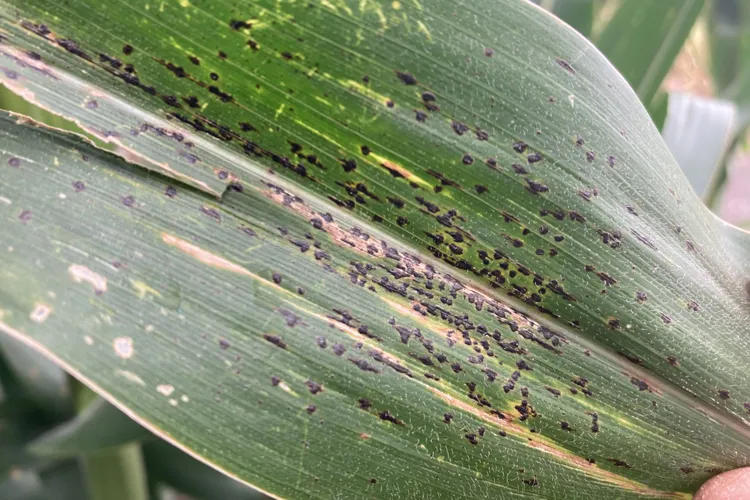
The disease, caused by the fungus Phyllachora maydis, can lead to substantial yield reductions if left unmanaged. It is characterized by small, black, raised spots on corn leaves that resemble tar. Infection typically occurs during periods of prolonged leaf wetness and moderate temperatures, making humid conditions particularly favorable for its spread.
Crop Progress in Virginia
The latest Crop Progress report, published July 13, said 69% of the Virginia corn crop had reached the silk growth stage by the week that ended July 12. That is 5 percentage points ahead of the five-year average and 2 points ahead of last year at this time.
The department said 19% of Virginia corn had reached the dough growth stage. The five-year average is 24%. Last year at this time, 25% of the crop had reached this milestone.
The USDA rated the condition of the state’s corn 1% very poor, 13% poor, 52% fair, 29% good, and 5% excellent. This is generally worse than the five-year average of 3% very poor, 12% poor, 22% fair, 54% good, and 9% excellent.
Management and Monitoring
As tar spot continues to spread across the Midwest and Mid-Atlantic regions, growers are advised to monitor their fields closely. Early detection is critical for effective management, as fungicide applications are most effective when applied preventatively or at the first sign of disease.
Farmers should work with their local Extension agents to develop integrated management plans that include crop rotation, resistant hybrids, and timely fungicide applications. The confirmation of tar spot in Culpeper County underscores the importance of vigilance as the growing season progresses.