
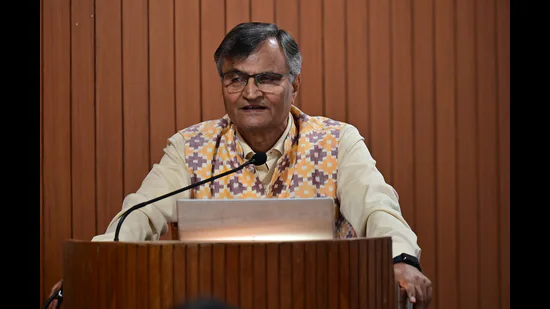
NITI Aayog member Ramesh Chand has flagged the persistent overproduction of paddy in India, warning that the current agricultural model—heavily reliant on rice and wheat—has become economically and ecologically unsustainable . Speaking at a high-level colloquium in Chandigarh, he called for a strategic shift from sarkari fasal (government-procured crops) to bazari fasal (market-driven crops) to secure long-term farmer prosperity .
Chand questioned why policymakers have been “thinking in perpetuity” only about food security for 50 years, hinting that the nation has accumulated enough stocks and must now prioritize income growth and sustainability .
The problem of overflowing stocks
Data presented by economists at the event laid bare the scale of the imbalance. The central pool currently holds approximately 71 million tonnes of rice, far exceeding the buffer requirement of just 7.6 million tonnes . This glut has forced the government to use subsidized rice for ethanol production, purchasing grain at inflated support prices and selling it to distilleries at a loss .
On the ground, the consequences are becoming increasingly visible. In Punjab, storage godowns are overflowing, and rice millers have managed to process only about 25 per cent of procured paddy, compared to nearly 60 per cent in a normal year . As wheat harvesting begins in April, officials fear a severe logistical crisis with no space to store fresh grain .
Beyond fiscal waste, experts pointed to severe environmental degradation. Paddy consumes disproportionate amounts of water, and the free electricity supplied to pump groundwater has led to a sharp decline in the water table, dropping by 1.7 feet per year in some districts . The two crops also absorb approximately 56 per cent of the nation’s subsidized urea, degrading soil health and inflating the fertilizer subsidy bill .
The path to diversification
Chand urged farmers not to abandon paddy abruptly but to gradually shift 10 per cent of the area over a decade. He identified maize as a “very promising” alternative, noting rapid technological advancements in states like Tamil Nadu, and suggested that horticulture could bring in five times more income .
To facilitate this transition, experts called for the repurposing of power subsidies into cash transfers, allowing farmers to choose less water-intensive crops without losing support. They also pushed for contract farming for high-value crops and a robust price stabilization fund like Haryana’s Bhawantar Scheme .
As Chand noted, the states have the best alluvial soil and near-universal irrigation. However, he warned that the region’s contribution to the national economy has shrunk from 6.2 per cent in the 1990s to just 3.4 per cent, and that per capita income has slipped from the top rank to 12th . Without a shift, the economic decline may accelerate, leaving future generations with depleted soil and shrinking incomes.