
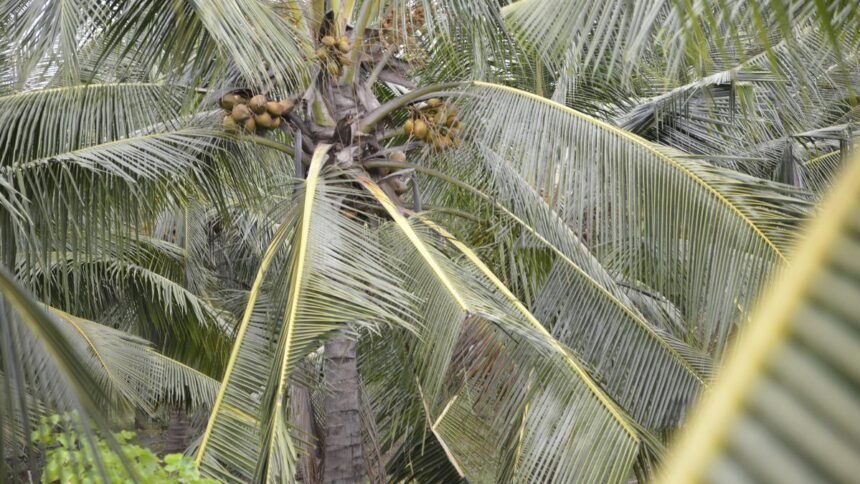
Coconut is one of the largest horticultural crops in peninsular India, with Karnataka, Tamil Nadu, and Kerala together accounting for about 82-83% of the country’s coconut production . This carefully cultivated landscape is now under threat from a microscopic adversary: phytoplasma. Specifically, phytoplasma-induced root wilt disease has destroyed large tracts of traditional coconut-growing areas across these states.
More than 150 years of sustained scientific research at the Central Plantation Crops Research Institute (CPCRI), Kayamkulam, has yet to yield a definitive cure for this debilitating condition . Recent assessments indicate that more than 30 lakh coconut palms have already been affected across major coconut-growing regions . In areas such as Pollachi, where farmers have adopted intercropping systems with shade-loving crops like cocoa and nutmeg, the situation has turned into a double disaster—without the shade of the coconut canopy, these crops simply succumb to thermal stress .
The limits of conventional approaches
Research institutions have attempted to address this plight through two broad approaches: developing standardised integrated cultivation practices using a mix of organic and inorganic inputs, and developing resistant and tolerant varieties. However, farmers who have followed the recommended practices contend that these measures have done little to prevent the spread of the disease .
Once a tree is infested, symptoms appear only after a prolonged incubation period. The tree quickly becomes unproductive, sheds all its nuts, and assumes a distorted appearance. Even if the disease is not immediately fatal, the palm continues to act as a source of pathogen inoculum .
CPCRI Kayamkulam has released one resistant and three tolerant varieties. However, production has been limited to only a few thousand seedlings a year, far short of what is needed to replace the vast number of palms being felled .
The participatory alternative
A more prudent and sustainable approach would be to tap into the reservoir of genetic wealth already standing in farmers’ fields within highly infested endemic zones. Coconut palms that display tolerance under high inoculum pressure and intense vector load hold the key to combating phytoplasma .
A participatory approach to selection offers a credible pathway to addressing the central constraint in combating phytoplasma. In highly infested regions, systematic participatory selection of coconut palms, combined with structured observation, can be undertaken with farmers playing a central role .
With appropriate training, farmers can be enabled to identify potentially tolerant palms and can be instructed on the importance of careful, long-term observation and record-keeping. This would significantly reduce the burden on scientific institutions while generating richer, field-relevant datasets .
Evidence from the field
The effectiveness of this approach has been demonstrated through various initiatives. In three Grama Panchayats in Kerala’s Alappuzha district, a community-level participatory action research project from 2019 to 2021 saw 90 coconut farmers participate in producing West Coast Tall seedlings tolerant to root wilt disease . Partners included extension agents, coconut producers’ societies, women self-help groups, and farm labour organizations. The coconut farmers’ understanding significantly improved as a result of these participatory interventions .
Earlier, between 1999 and 2003, a Participatory Technology Transfer (PTT) approach in Alappuzha district showed remarkable results. The impact analysis indicated significant improvement in awareness (from 14% to 32.5%), knowledge (from 19% to 59.5%), attitude (from 22.5% to 36.5%) and adoption (from 16% to 45.5%) of recommended practices . The PTT enabled participation of major stakeholders in the technology transfer process, with higher adoption levels jumping from 27.5% to 57% after three years of implementation .
The way forward
Once tolerant or resistant palms are identified and validated, they can be inducted into decentralised breeding programmes, allowing multiple small, independent selection and evaluation efforts to proceed simultaneously under scientific supervision. Such an approach also enables the isolation of locally adapted varieties suited to specific agro-climatic conditions .
Given the rapid expansion of root wilt disease into new frontiers, time is of the essence. Farmers whose palms are selected for breeding can also benefit through royalty mechanisms envisioned under the Protection of Plant Varieties and Farmers’ Rights Act while being encouraged to establish nurseries .
Addressing root wilt at this scale requires coordinated institutional action. Central agencies such as CPCRI and the Coconut Development Board must work closely with the agricultural universities of Kerala, Tamil Nadu, and Karnataka. Fragmented research efforts and parallel trials no longer suffice in the face of a fast-spreading phytoplasma threat . A shared framework for data, evaluation, and field validation is essential to translate participatory science into impact .