

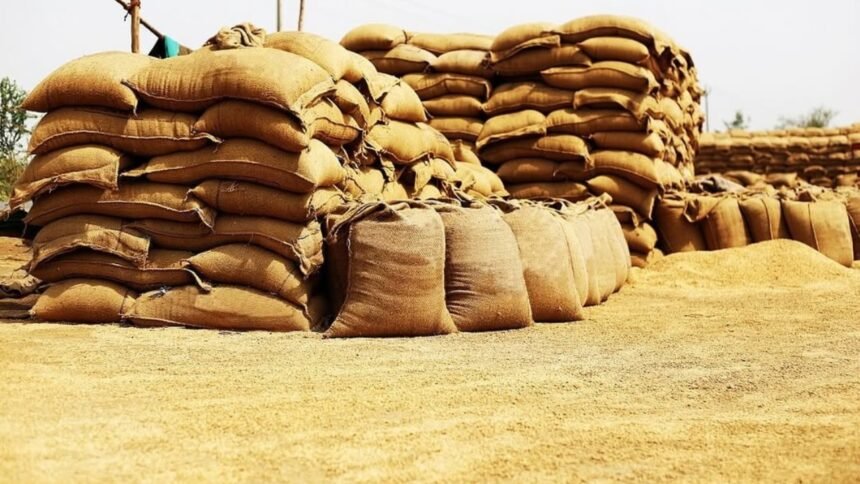
Most crops are being sold at prices lower than the minimum support price (MSP) fixed for the Rabi season 2026, making it difficult for farmers to recover their costs. The latest weekly report of the Crop Weather Watch Group under the Union Ministry of Agriculture and Farmers Welfare confirms that wholesale prices of 12 crops are less than MSP.
These 12 crops include wheat, maize, pigeon pea, gram, lentils, moong, urad, jowar, bajra, ragi, groundnut, and sunflower – covering a significant portion of India’s Rabi harvest.
The Numbers – How Far Below MSP?
Among coarse cereals being encouraged by the government, the prices of ragi, maize, and bajra have fallen the most.
| Crop | MSP (Rs/quintal) | Market Price (Rs/quintal) | Shortfall | Percentage Below MSP |
|---|---|---|---|---|
| Ragi | 4,886 | 3,092 | 1,794 | 36.72% |
| Maize | 2,400 | 1,689 | 711 | 29.63% |
| Bajra | 2,775 | 2,161 | 614 | 22.13% |
Wheat and Gram – The Core Rabi Crops
Rajesh Shivhare , an arhtiya (agricultural broker) in Barigarh town, Chhatarpur district, Madhya Pradesh, told Down To Earth:
| Crop | MSP (Rs/quintal) | Market Price (Rs/quintal) | Shortfall |
|---|---|---|---|
| Gram | 5,875 | 5,000 | 875 |
| Wheat | 2,585 | 2,000-2,100 | 485-585 |
Why Are Prices Falling?
Several factors are contributing to the price crash:
Sudden Arrival of Produce
Ghanshyam , an arhtiya in the grain market in Mahoba, told DTE that the price of all crops has come down due to the sudden arrival of produce. When large quantities hit the market simultaneously, prices naturally decline.
Moisture Issues Due to Unseasonal Rains
Ashok Nigam , a local journalist in Banda district, Uttar Pradesh, pointed out that there is moisture in wheat due to unseasonal rains , because of which government procurement has been hampered. Damaged or moist grain is often rejected by procurement agencies, forcing farmers to sell to private traders at lower prices.
Lack of Government Procurement
Due to the lack of government procurement at MSP, farmers are having to sell their produce at throwaway prices because they have to pay for harvesting, labour, irrigation, etc. soon.
Farmer Distress – ‘No Point in Selling’
Bindravan , a farmer from Pupwara village in Uttar Pradesh’s Mahoba district, told DTE that he had planted white peas this year. They are currently being sold at Rs 3,000 per quintal , compared to Rs 4,500-5,000 per quintal last year.
He said there was no point in selling the crop at this price.
Why Farmers Sell at a Loss Anyway
| Reason | Explanation |
|---|---|
| Immediate expenses | Harvesting, labour, irrigation bills due |
| Storage costs | Holding crop requires storage space and risk |
| Transport costs | Government markets far from villages |
| Quality concerns | Moisture-damaged grain may not store well |
The Transportation Barrier
Bindravan and most farmers in surrounding villages sell their produce to arhtiyas in Kharela town because:
- The government market is far from their village
- The cost of transporting the crop to the government market is high
This creates a classic trap: farmers cannot afford to reach the very markets that might offer MSP.
The One Bright Spot – Mustard
Only one crop is holding its ground:
| Crop | Current Price (Rs/quintal) | MSP Status |
|---|---|---|
| Mustard | 6,200 – 6,600 | At or above MSP |
Ghanshyam added that only mustard is best priced, currently being sold at Rs 6,200-Rs 6,600 per quintal. This is the only crop in the entire market which is being sold at its proper MSP or more.
Mustard’s relative success may be due to:
- Strong demand for edible oils
- Lower supply compared to other Rabi crops
- Better procurement mechanisms
The 12 Crops Affected
The Crop Weather Watch Group report identified 12 crops being sold below MSP:
| Cereals | Pulses | Oilseeds |
|---|---|---|
| Wheat | Pigeon pea (arhar) | Groundnut |
| Maize | Gram (chana) | Sunflower |
| Jowar | Lentils (masoor) | — |
| Bajra | Moong | — |
| Ragi | Urad | — |
This breadth of affected crops – across cereals, pulses, and oilseeds – indicates a systemic pricing problem , not an issue limited to one or two commodities.
The MSP Mechanism – What It Is and Why It Matters
| Aspect | Detail |
|---|---|
| Full form | Minimum Support Price |
| Purpose | Government-set price to protect farmers from market crashes |
| Announced by | Cabinet Committee on Economic Affairs (CCEA) |
| Procurement by | FCI, NAFED, state agencies |
| Current wheat MSP (2026-27) | Rs 2,585 per quintal |
When MSP works as intended, the government buys crops at the announced price even if market prices fall lower. This provides a safety net for farmers. However, when procurement is delayed, limited, or hampered by quality issues, farmers are forced to sell to private traders at lower prices.
The Rabi Season 2026 Context
The Rabi (winter) season typically runs from October to March, with harvest beginning in April. Key factors affecting this year’s harvest:
| Factor | Impact |
|---|---|
| Unseasonal rains | Moisture damage to wheat |
| Sudden market arrival | Oversupply depressing prices |
| Limited procurement | Government buying hampered by quality concerns |
| High input costs | Farmers need immediate cash to pay bills |
What Can Be Done?
Based on the article’s findings and standard policy responses:
| Recommendation | Purpose |
|---|---|
| Expand procurement centres | Reduce farmer transport costs |
| Relax quality norms | Accept moisture-damaged grain (as done in Punjab, Haryana) |
| Strengthen price monitoring | Detect and prevent market manipulation |
| Improve storage infrastructure | Allow farmers to wait for better prices |
| Direct MSP payments | Compensate farmers for difference between market price and MSP |
The government has previously relaxed quality norms in Punjab, Haryana, and Rajasthan for wheat. Similar action may be needed for other crops and states.
A Crisis of Implementation
The MSP system is only as good as its implementation. When government procurement is delayed, limited, or hampered by quality restrictions, the safety net fails. Currently, farmers across India are experiencing that failure.
Twelve crops – including staples like wheat, gram, and coarse cereals – are being sold below MSP. Ragi is at a staggering 36.72% below its support price. Farmers are selling at throwaway prices not because they want to, but because they have no choice: bills are due, storage is limited, and government markets are far away.
Only mustard is holding its ground – a solitary bright spot in an otherwise bleak pricing picture.
As one farmer put it: “There was no point in selling the crop at this price.” Yet sell he must.
The question for policymakers is whether this Rabi season will be a wake-up call – or just another year of farmer distress ignored until the next harvest.