

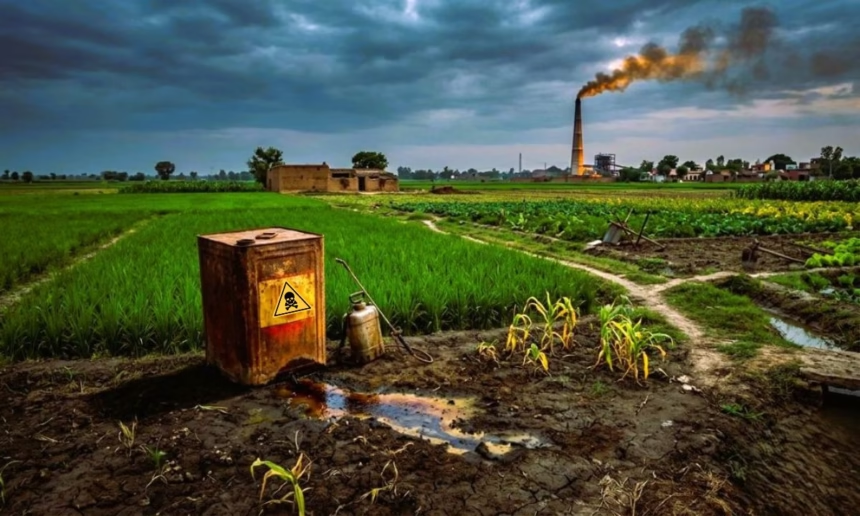
India’s agricultural success story has a hidden cost. Despite being one of the world’s largest producers and consumers of pesticides, a significant share of the chemicals used in Indian farming falls under the category of Highly Hazardous Pesticides (HHPs)—substances that cause severe acute toxicity, persist in soil and water, and pose serious risks to human health and ecosystems .
A 2025 report by Pesticide Action Network Asia Pacific (PANAP) found that India accounted for the highest proportion of HHPs among four Asian countries surveyed, with 29 of the 41 pesticides used in India—70.73%—classified as highly hazardous .
The Human Cost of Hazardous Pesticides
India has witnessed severe health disasters linked to pesticide exposure. The endosulfan tragedy in Kerala, often compared to the Bhopal gas tragedy, caused widespread health damage across generations . More recently, Yavatmal district in Maharashtra gained national attention in 2017 for pesticide-related deaths and hospitalizations. Official reports recorded over 450 cases of pesticide poisoning and 23 fatalities among cotton farmers .
The PANAP survey found that among 1,993 respondents in India, unsafe practices were widespread. Approximately 40% of farmers reported not using personal protective equipment (PPE), with surgical masks—which do not comply with international guidelines—commonly used instead of proper protection. Over 60% of farmers reported health symptoms after pesticide use .
A February 2026 study in The National Medical Journal of India described paraquat dichloride, a widely used herbicide, as a “highly toxic compound” associated with high mortality rates and long-term health complications, including hepato-renal failure, progressive lung fibrosis, and Parkinson’s disease .
Food Safety and Export Risks
The problem extends beyond farm health to consumer safety. ICAR data shows that between 2018 and 2023, pesticide residues were detected in 28% of food samples analyzed . Indian agricultural exports have also suffered, with export rejections varying from 15–35% for spices to various international destinations. The number of non-basmati rice consignments rejected by the European Union increased from 3 in 2020 to 37 in 2024 .
The stricter residue norms in markets like the European Union are already pressuring Indian exports. Industry bodies have flagged that nearly 40 million kilograms of premium tea exports to Europe and the UK are exposed to tighter residue requirements .
Regulatory Framework: Progress and Gaps
India regulates pesticides under the Insecticides Act, 1968, a law that experts say has become redundant and does not reflect current ground realities . A draft Pesticides Management Bill has been proposed to replace the six-decade-old legislation, but critics argue the new draft weakens precautionary safeguards, centralizes power, and prioritizes “ease of doing business” over public interest .
The draft bill proposes a centralized registration system with deemed approval provisions—if no decision is taken within 18 months for generic pesticides, registration is automatically granted. Experts warn this approach could dilute accountability .
Why Hazardous Pesticides Persist
Several factors drive the continued use of HHPs in India:
Affordability and availability – Hazardous pesticides remain cheaper and widely available through local dealer networks. In many regions, informal or illegal supply chains continue to circulate banned chemicals .
Immediate effectiveness – Farmers face up to 30–40% yield losses due to pests. Fast-acting chemical pesticides offer visible, immediate results, strengthening behavioral dependence .
Limited awareness – A large share of farmers lack proper training in safe pesticide use, with many relying on input dealers for guidance .
Weak enforcement – State-level monitoring and compliance mechanisms are inconsistent. Telangana and Odisha have imposed temporary bans on paraquat, but states lack power to enforce permanent prohibitions without central approval .
Illegal online sales – The Central Consumer Protection Authority (CCPA) recently ordered an investigation into e-commerce platforms selling unregistered herbicides, highlighting gaps in digital marketplace regulation .
Proposed Bans and Industry Pushback
The government is preparing to impose a nationwide ban on paraquat dichloride following an expert panel’s recommendation . However, industry bodies have expressed concerns, arguing that alternative herbicides could raise weed-management costs by two to ten times, while non-chemical methods may cost “tens to hundreds of times” more .
CropLife India, the industry body of pesticide manufacturers, has urged the inclusion of time-bound data protection frameworks for new molecules, arguing that outdated chemistries lead to resistance, increased spray intensity, and difficulty meeting export residue standards .