
For decades, food security in India has been viewed through a humanitarian lens – as a matter of poverty alleviation, welfare distribution, and rural livelihoods. But a growing chorus of strategic analysts argues that this framing is dangerously outdated.
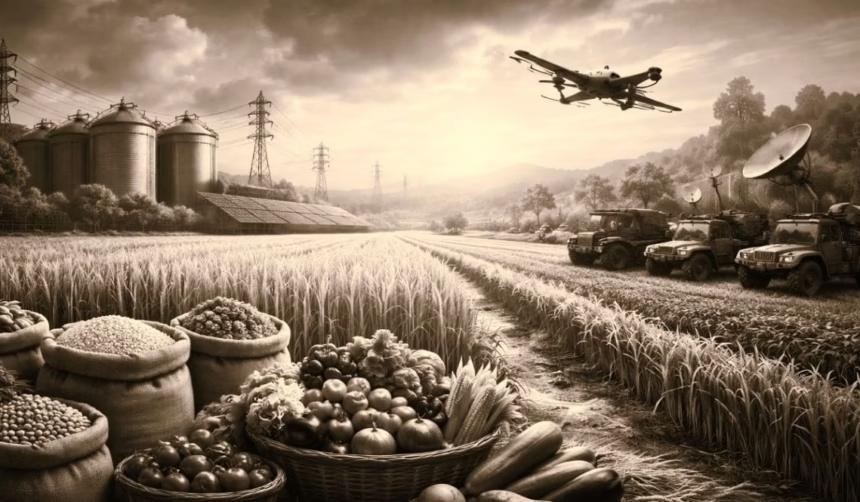
In an era of climate volatility, geopolitical fragmentation, and supply chain weaponization, food security must be reclassified as a core component of national security.
The strategic logic
India is the world’s most populous nation and the second-largest producer of wheat and rice. Yet its agricultural system remains vulnerable to monsoon failure, groundwater depletion, and heat waves. The 2023 ban on rice exports following erratic rainfall demonstrated how quickly domestic food concerns can override global trade commitments.
“Food is not a commodity. It is a weapon. And countries that cannot feed themselves have no real strategic autonomy,” says retired Lieutenant General A.B. Shivane, who has written extensively on climate security.
He points to the 2022 wheat crisis following Russia’s invasion of Ukraine, when over 30 nations banned food exports. India, largely self-sufficient in staples, weathered the storm. But margins are thinning.
Climate change as threat multiplier
The Intergovernmental Panel on Climate Change (IPCC) projects that for every 1°C rise in temperature, wheat yields decline by 6% and rice by 3.2% in tropical regions. India’s average temperature has already risen by 0.7°C since 1900, with extreme heat events increasing five-fold since 2015.
The 2025 heat wave reduced wheat output by an estimated 12%, forcing the government to dip into buffer stocks earlier than planned. For a country with 800 million citizens dependent on subsidized food grains, such shocks have direct implications for social stability.
The import dependency paradox
India is self-sufficient in rice, wheat, and sugar but heavily dependent on imports for pulses (15%), edible oils (60%), and fertilizer inputs (over 90% of potash and 70% of rock phosphate).
Supply disruptions – whether from climate events, port blockades, or diplomatic standoffs – can cripple domestic agriculture. The 2025 Red Sea crisis increased shipping costs for Indian agricultural imports by 300%, directly impacting farmer input costs.
“Strategic autonomy requires not just production but also supply chain resilience,” notes economist and former chief statistician Pronab Sen. “We need to map every critical agricultural input, identify vulnerabilities, and build alternatives.”
The silent weapon: water security
Agriculture consumes 90% of India’s freshwater. Groundwater levels in Punjab, Haryana, and western Uttar Pradesh – the country’s breadbasket – are declining at 0.5 meters per year. By 2030, the World Bank estimates that 60% of India’s aquifers will be in critical condition.
Without water, food security collapses. And without food, national security collapses. The linkage is direct, yet rarely appears in defense planning.
“We spend crores on border security but neglect the water security that sustains our farming border communities,” says environmental researcher Himanshu Thakkar. “A farmer who cannot irrigate his land is a security risk, not because he turns militant but because he leaves the land – and the border becomes empty.”
Reimagining agriculture in the National Security Framework
Integrating food security into India’s security architecture would require three fundamental shifts:
1. Move agriculture from the Ministry of Agriculture to a National Security Council oversight – At least for strategic commodities (staples, pulses, oilseeds). This would prioritize agri-investment alongside defense spending.
2. Build strategic grain reserves in multiple climate zones – Currently, most buffer stocks are stored in Punjab, Haryana, and Madhya Pradesh. Diversified storage locations reduce climate and conflict risk.
3. Climate-proof critical supply chains – Identify import dependency risks and develop domestic alternatives or diversified foreign sources for fertilizers, edible oils, and pulses.
International precedents
China maintains a “red line” of 1.2 million square kilometers of arable land – an area the size of South Africa – protected from industrial development. It stockpiles enough grain to feed its population for 18 months without imports.
Israel, despite 60% desert, achieved food security through drip irrigation, desalination, and climate-resilient crop breeding – all managed under a national security directive.
India has neither the land constraints of Israel nor the authoritarian controls of China. But it does have climate vulnerability, population pressure, and geopolitical rivals who understand the weaponization of food.
The cost of inaction
The government’s food subsidy bill already exceeds ₹5 lakh crore annually – more than the defense budget. Without systemic reform, climate-driven crop failures will push this figure much higher.
More ominously, food inflation has triggered civil unrest in over 30 countries since 2008. India has been relatively stable, but the margin for error is shrinking.
As the 2026 heat wave intensifies and groundwater levels continue to fall, the question is no longer whether food security is a national security issue – but whether India will act in time.