
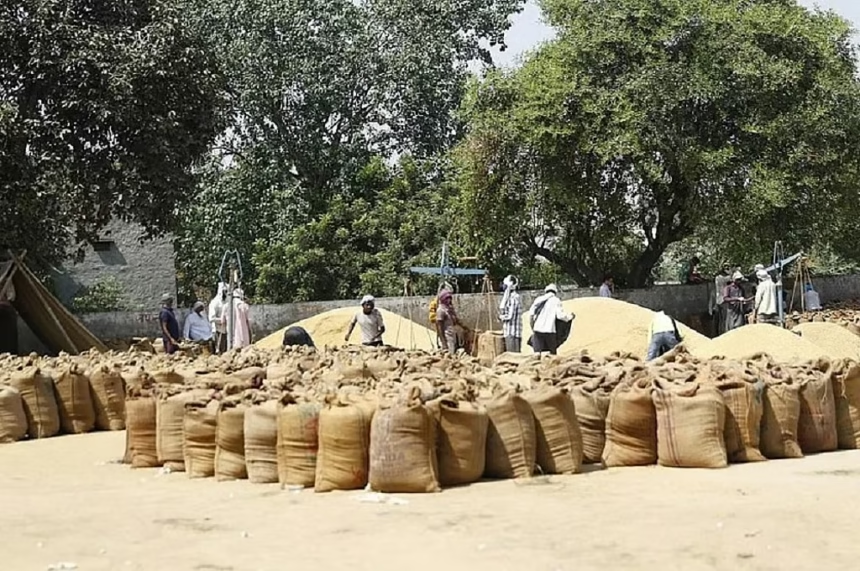
As the wheat harvesting season draws to a close across most of North India, the government’s procurement operations have hit a peculiar speed bump. While the total quantity purchased has broken records, surpassing the revised target of 34.5 million tonnes (MT) , the pace of purchases and, more critically, the flow of payments to farmers has decelerated in key states, raising concerns as the season enters its final leg .
Procurement Targets Exceeded
According to data released by the Food Corporation of India (FCI), the government has successfully procured approximately 34.9 MT of wheat as of June 1, 2026. This is the highest procurement figure in the last four years, marking a 17% increase compared to the 29.8 MT purchased by the end of May last year .
This achievement is largely attributed to a record harvest. The Agriculture Ministry has estimated wheat production for the 2025-26 crop year at a record 120.65 million tonnes, creating a massive marketable surplus .
The State-Wise Performance
While national figures look robust, the distribution of purchases has been uneven, explaining the perception of a slowdown :
- Punjab & Haryana: Operations in these states concluded swiftly, reaching near their targets of 12.2 MT and 7.2 MT respectively.
- Madhya Pradesh (MP): The state witnessed a massive surge, procuring 10.44 MT. This is a 34% increase from the previous year, driven by high arrivals. However, this surge also overwhelmed local infrastructure, leading to logistical delays and slower payment processing .
- Uttar Pradesh (UP): Procurement lagged significantly, reaching only 1.7 MT against a target of 2.5 MT.
Union Agriculture Minister Shivraj Singh Chouhan had flagged challenges in MP earlier in the season, directing officials to resolve “slot booking, registration, and verification” issues to ensure farmers didn’t face distress while selling their produce .
Relaxed Norms Ensure Farmer Participation
An important factor enabling the high procurement has been the relaxation of quality norms. In response to unseasonal rains that caused “lustre loss” and an increase in shriveled grains, the government relaxed the procurement standards .
This allowed damaged crops to be purchased under the Minimum Support Price (MSP) umbrella. “Ensuring fair value for the hard work of our annadatas is our responsibility,” Chief Minister Rekha Gupta stated after Delhi implemented similar relaxations, a sentiment echoed by central agencies nationwide .